

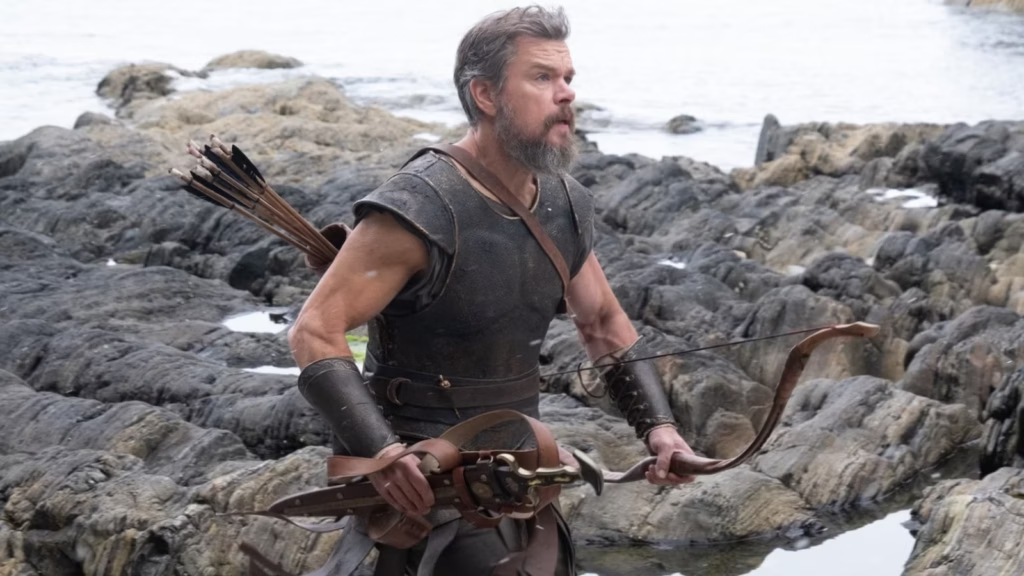
Matt Damon as Odysseus in The Odyssey (2026)
Before I delve into a discussion of The Odyssey, I want to share my personal feelings on book adaptations. Many people have an idea of what an adaptation should be, and most feel it should be a mirror image of a book. Yet that isn’t necessarily true. I have seen adaptations, such as Kiss the Girls (1997), that followed the book to a T, but didn’t grab me like the book did. There are also adaptations that don’t make sense unless you read the book. (The best example is David Lynch’s Dune (1984), which had the misfortune of trying to cram a long book into a two-hour film.) As a better approach, there are adaptations that improve upon the source material, such as Jaws (1976), which trims subplots out, adds in new interesting scenes, like its monologue about the sinking of USS Indianapolis, and gives a much more exciting ending. Finally, there is the worst kind of adaptation, which is not only a poor adaptation but also a poor film in itself.
The best case of this, for me, was The Bonfire of the Vanities (1990). Bonfire is one of my favorite books and among my least favorite films. To give an example of what went wrong, I will share a scene that is not in the book, and you don’t have read the book to see it is a horrible scene. At the end of Bonfire, Judge Morgan Freeman is called a racist by a courtroom spectator for letting Tom Hanks go free. Not only does that make no sense, but the scene becomes wackier. The courtroom has entered into pandemonium following Hanks’ acquittal. Yet Freeman calms everyone down by giving a speech that ends, “Decency is what your grandmother taught you. It’s in your bones. Now, you go home. Go home and be decent people. Be decent.” This speech is enough for everyone in the courtroom to calm back down and behave. As a viewer, the mind boggles. The point I am making here is that while everyone has their own idea of what a book adaptation should be, I believe it is important for us to ask a crunch question: does this work as a film in itself? Let’s treat any adaptation of a film as we would a film that was not adapted from a literary source.
I bring this up because when the second batch of pre-release footage of The Odyssey was teased, it stirred up some controversy. In particular, scholars began to raise questions about the film’s accuracy and authenticity. They complained that the characters were speaking English instead of Ancient Greek, and they noted that the costumes weren’t correct. Then, some of the casting choices drove anti-woke warriors nuts: trans actor Elliot Page playing Sinon, a Greek warrior (initial reports stated that he was playing Achilles), and Helen of Troy played by a Black actress, Lupita Nyong’o.
That the director was Christopher Nolan, whose last film was Oppenheimer (2023), did little to alleviate concerns. Fortunately, more audience members were of my mindset and trusted Nolan based on his good track record, while keeping an open mind about how he would adapt Homer’s poem. Also, I was sure the film would look great on IMAX, regardless of its other pros and cons. So, we turned out to see the film on its release, and The Odyssey attracted a great box office weekend viewership of 264.1 million internationally. This marked Nolan’s biggest opening weekend and also the third-largest of 2026 (following Super Mario and Toy Story 5, making it the biggest opening of a live-action film this year).
Now, on to the film. I want to start off by noting that, in an interview with Nolan, Jon Stewart proposed that the film felt like a thematic sequel to Oppenheimer, and Nolan did not disagree with this. In fact, both films follow men who were successful in their pursuits, but also feel guilt and worry about the world they have created. Oppenheimer has created the atomic bomb, but begins to have regrets when Germany surrenders, and feels more anguished still when Truman drops the bomb on Japan. Meanwhile, Odysseus (portrayed by Matt Damon) masterminds the Trojan Horse, which wins the war, but he is then wracked with guilt at how many innocent people in Troy were slaughtered. On this plot point, a wave of social media posts from viewers have claimed that Homer never had Odysseus show remorse, but as of today, I have seen a post correcting that critique, with the user sharing an excerpt where Homer mentions Odysseus’ feelings of remorse about the war.
Another similarity we can draw between the two Nolan releases is that, in both films, Oppenheimer and Odysseus try to proceed with the best foot forward after their actions. As Oppenheimer refuses to let the atomic bomb enter the Cold War era, Lewis Strauss stages a McCarthy witch hunt against him. Likewise, Odysseus has lost a lot of men, but he is determined throughout most of the film to bring his remaining soldiers home safely, even though he is told by Gods, witches, and ghosts that he will be the only one to survive.
Let’s draw one final comparison between Oppenheimer and The Odyssey. I would be remiss if I didn’t mention that both films are three hours long, yet they never feel like they lag. Perhaps one factor helping to engage viewers is the decision in both films to tell the story all over the map of time, rather than chronologically. Nolan cuts between Odysseus traveling home, Penelope (Anne Hathaway) courting the endless would-be suitors in her home, and Odysseus trying to recount to Calypso (Charlize Theron) how he arrived there. Yet the viewer is never lost in following these events.
Now, with the comparisons out of the way, I want to move to a crucial element of the film as we see it on-screen: the visual absence of the Gods (with the exception of Zendaya as Athena). Some viewers have not liked this, but I appreciate the decision from Nolan. In our world with many religions, a lot of religious people talk about God, feel God watching over them, and yet never see God. This is how Nolan portrays it here. The Gods are never shown, but the characters feel their presence. To me, this gives the film a more realistic feel.
We see this Godly presence enacted through the characters’ respect for Zeus’s Law. It is a sacred code dictating that hosts must welcome travelers with food, drink, and shelter without judging them, as guests could be Gods in disguise, while in turn, guests must behave respectfully. This is the reason why Troy accepts the Trojan Horse, and it is why Penelope accepts her suitors’ visits. Even when Odysseus makes it back to Penelope’s home dressed as a beggar, he is allowed in because of Zeus’s Law. Not only that, but one reason why Odysseus feels regret about the Trojan War is that he feels he breached Zeus’s Law. The men in the horse were let in by the people of Troy thanks to that Law, only for Odysseus’ army to slaughter them. Odysseus feels his deception gives tacit permission for others to violate the Law across the Mediterranean, which he fears may ultimately lead civilization to collapse.
In the film, the Gods continue to make their presence known without being seen. For instance, after Odysseus blinds the Cyclops, we find out that the Cyclops is the son of the God Poseidon. So, without seeing Poseidon, we understand why the ocean is becoming increasingly hard to navigate, making it impossible to reach home. Likewise, when Calypso is asked to release Odysseus, she hears a clap of thunder, and while this is not the voice of Zeus, she realizes she must obey.
It should also be mentioned that a lot of scenes in themselves are stand-out: they are well-shot and well-acted. The Trojan horse is one. Another is the scene with Circe (Samantha Morton), who greets Odysseus’ men initially as a scared woman, but then, as they enter her house and eat the food she cooks, they slowly begin to realize she is not who she seemed, and it is they who should be afraid of her. Finally, I have to highlight the climax of the film, where Penelope declares she will marry whoever can fire Odysseus’ bow and hit the target. We know Odysseus is there, and we are waiting for the moment when he will pass Penelope’s test.
Essentially, Nolan has made an epic, and something big for the IMAX screen. Alongside that, there are some key takeaways from his interpretation: the feeling of remorse and wondering what the world has become after the protagonist succeeds. There is also the sense of respecting the honor codes long-held. In this case, there is a price to be paid for disobeying the Gods: potentially the collapse of civilization. From a secular viewpoint, you can say there are rules to be respected, and civilization’s survival depends on people following them.
While I have enjoyed Nolan’s interpretation, I am struck by the many discussions about it on social media, particularly among scholars and fans of Homer. People may agree or disagree with Nolan’s choices, but I like this effect of the film having ignited discussion for various reasons. For one thing, it is bringing about a huge interest in Ancient Greek culture in the mainstream. Also, just like his work with Oppenheimer, Nolan is reinventing the wheel of a blockbuster film. Rather than entertaining us with a sequel or a comic book, he is drawing our attention to a period from history, and greatly succeeding in attracting modern-day viewers to the theater to watch.
